The Fingers of Punta del Este
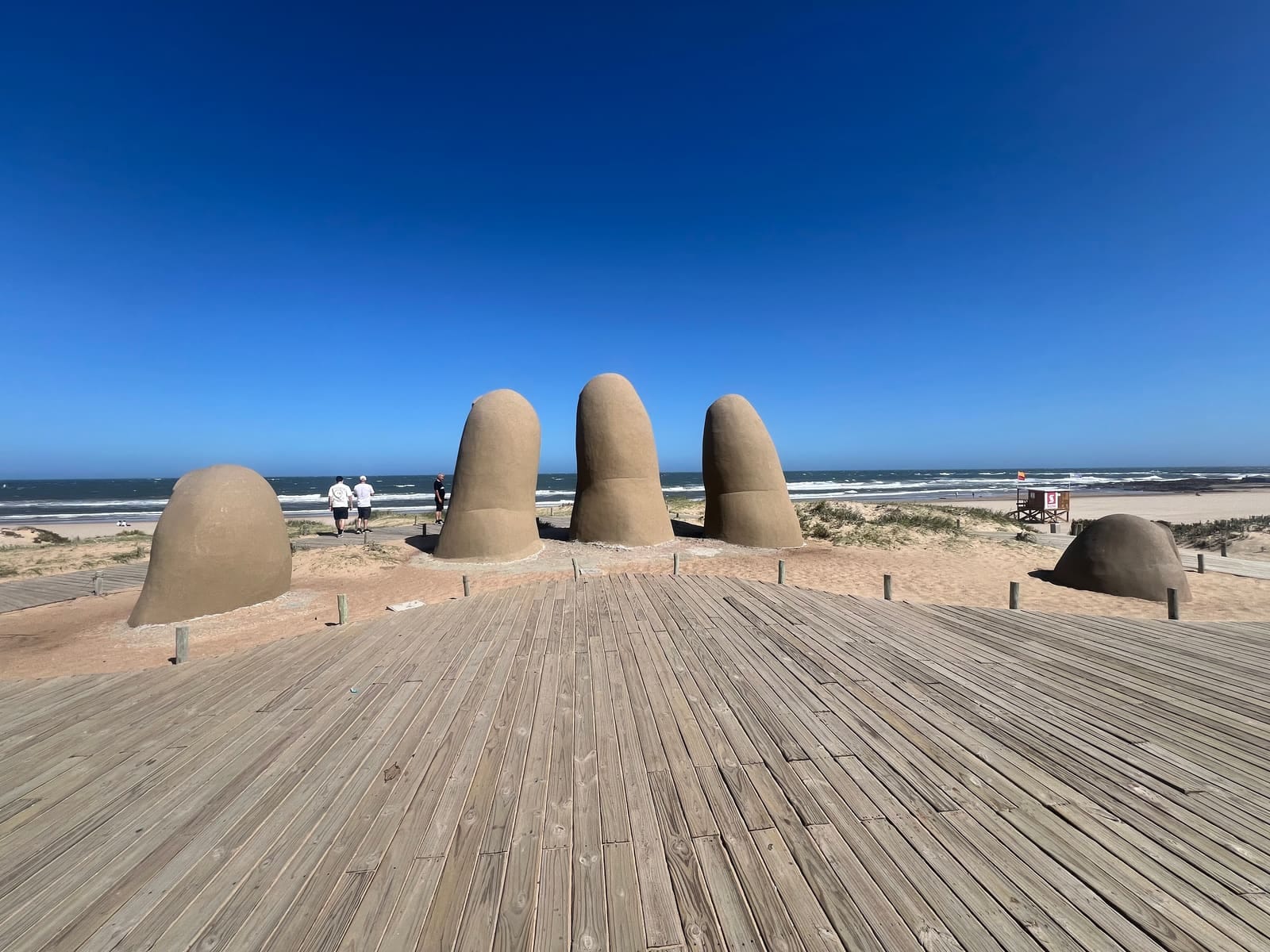
La Mano — Man Emerging into Life, main view in Punta del Este, Uruguay
⭐ 4.5(28,416) · 28,416 reviews

The Fingers of Punta del Este (La Mano) — Man Emerging into Life

A monumental hand rising from the sand of Brava Beach — one of Uruguay's most iconic landmarks.

🕒 Open 24 hours

📍 View Location
Address
Av. Eduardo Víctor Haedo km 162.500, Stop 1 Brava, 20001 Punta del Este, Maldonado, Uruguay
Plus Code
23R7+R3 La Barra, Maldonado, Uruguay
Hours
24 hours / every day

Punta del Este Weather

Check current conditions and the 7-day forecast to plan your visit to La Mano on Brava Beach.

9°C
Showers
Feels like 7°C · 9° / 15°
💧 Humidity
92%
🌬️ Wind
10 km/h
🌧️ Rain chance
72%
☀️ UV index
6

What to expect & how to prepare

Weather alert
  • Heavy rain: avoid low-lying areas and flooded crossings.
What to wear
  • Pleasant temperature: comfortable clothing for walking.
  • Rain possible: a waterproof jacket is a good idea.
  • High UV: use sunscreen and avoid direct midday sun.
What to do
  • Not a good day for outdoor activities: prefer places under cover.
  • Calm sea: a good moment to walk the shoreline and watch the sunset.
What to pack
  • Folding umbrella
  • Sunscreen, sunglasses and a hat
  • A jacket for the temperature swing
🌬️ Wind force
3 Bft
🌊 Wave height
0.6 m
🌡️ Water temp.
12°C
🌅 Sunrise
06:46
🌇 Sunset
18:27

Tides

Mid tide
📍 Current level
0.18 m Rising
⬆️ Next high tide
18:25 · 0.24 m
⬇️ Next low tide
13:52 · 0.00 m
📊 Today's range
0.24 m
Sea level over the next 24 hours
0 m
05:52
0.18m
13:52
0.00m
18:25
0.24m
Now
06:00
12:00
18:00
00:00
Today's tides
⬇️ Low tide 01:54 · -0.01 m ⬆️ High tide 05:52 · 0.18 m ⬇️ Low tide 13:52 · 0.00 m ⬆️ High tide 18:25 · 0.24 m
  • The tide is coming in: stay off the rocks and do not linger on them.
Height above mean sea level · Astronomical prediction, for guidance only

7-Day Forecast

Today
15°
72%
Fri
14°
8%
Sat
13°
62%
Sun
10°
43%
Mon
11°
14%
Tue
14°
8%
Wed
15°
2%
Updated 05:45 Source: Open-Meteo

About La Mano — Man Emerging into Life

Welcome to La Mano (Man Emerging into Life), widely recognized as the central La Mano landmark and also known as The Fingers. Located in the heart of Punta del Este, Maldonado, Uruguay, this destination serves as a primary hub for travellers visiting the region.

Discover The Fingers of Punta del Este

The Fingers — also known as La Mano or Hombre emergiendo a la vida (Man Emerging into Life) — is a concrete sculpture of five human fingers breaking through the sand of Playa Brava. Created by Chilean artist Mario Irarrázabal in 1982 during an international sculpture workshop, it has become the unmistakable symbol of Punta del Este and one of the most photographed monuments in Uruguay.

About the Sculpture

The Fingers is a public artwork maintained by the Intendencia de Maldonado, the provincial government of Maldonado Department where Punta del Este is located. As one of Uruguay's most visited landmarks, it draws hundreds of thousands of visitors every year and stands as a landmark of modern Latin American public art.

Visitor Guide

  • Open 24 hours a day, 7 days a week — visit anytime, free of charge.
  • Located at Stop 1 of Playa Brava, Av. Eduardo Víctor Haedo, Punta del Este.
  • Best light for photos is early morning or late afternoon; sunrise is spectacular.
  • Easily reached on foot, by bike, or by bus from the city centre (about 15 minutes).

Highlights

  • Five fingers of a giant hand emerging from the sand
  • Designed by Chilean sculptor Mario Irarrázabal in 1982
  • One of the most recognizable symbols of Uruguay
  • Free, open-air public artwork on Brava Beach

When visiting La Mano (Man Emerging into Life), visitors can easily explore surrounding historical landmarks and points of interest, including the Punta del Este Lighthouse and Casapueblo.

History & Significance of La Mano — Man Emerging into Life

History, Meaning & Legend of La Mano

1

Origins: the 1982 sculptors' meeting

La Mano was born in the summer of 1982, during an international open-air sculptors' meeting held in Punta del Este. The event brought together artists from several countries who were asked to create monumental works in public view, facing the sea. The proposal by Chilean artist Mario Irarrázabal was the boldest: a giant hand emerging from the sand, as if an entire body lay buried beneath the beach. Conceived as land art — a piece designed to interact with the landscape — it was an immediate sensation and has stood in the same spot ever since.

2

The artist: Mario Irarrázabal

Mario Irarrázabal was born in Santiago, Chile, in 1940 and is one of Latin America's most recognised sculptors. Trained at the University of Chile and later in Germany, his work revolves around the human figure, monumental scale and the relationship between people and landscape. In 1982 he chose the beach as his canvas and concrete as his material. Years later he returned to the same motif in the Atacama Desert (Chile, 1992), where another giant hand rises from the sand — a variation on the gesture he had first tried in Punta del Este.

3

How it was built

The sculpture is made of reinforced concrete over a steel frame, moulded in situ on the sand of Brava Beach. Its five fingers rise at monumental scale, far taller than a person, so that visitors can measure their own size against the work. Anchored in the beach, the piece converses with the tide, the wind and the salt: sand covers and uncovers its base with the surf, and periodic maintenance by the Intendencia de Maldonado keeps its original appearance.

4

What does it mean?

Irarrázabal has explained that the work represents neither a drowned person nor a shipwreck, but the human being emerging from the earth into life — hence its full name, Man Emerging into Life. The open hand can be read as a gesture of help, farewell or wonder, and as a reminder of human fragility before the immensity of nature. The ambiguity is intentional: every visitor completes the meaning from their own experience.

5

Local legends and myths

Like any iconic work, La Mano has gathered its own legends. The most widespread speaks of a giant buried beneath the beach with only a hand showing; another says it belongs to a swimmer trapped by the sea, emerging to ask for help. It is also said that whoever touches the fingers will have good luck and return to Punta del Este. These are popular tales with no historical basis, yet they are part of the imagination the sculpture awakened in the community.

6

From artwork to symbol of the city

Over the decades, La Mano stopped being just another sculpture and became the image of Punta del Este and one of the most photographed monuments in Uruguay. It appears on postcards, guidebooks, tourism campaigns, music videos and social media, and is a favourite meeting point for visitors from around the world. Its instantly recognisable silhouette works as a natural logo for the city and anchors the lively Brava Beach, famous for its strong surf.

7

Conservation and maintenance

Exposed to wind, sand and sea salt, the work requires regular care. The Intendencia de Maldonado and maintenance crews carry out cleaning and repair work to preserve the concrete and the steel structure. The sculpture also stands in a protected public space, so visitors are asked not to climb on the fingers or leave litter, so that future generations find it as its author imagined it.

8

Curiosities and useful facts

The sculpture is free and accessible 24 hours a day, all year round. Many visitors think they see a whole body buried: in reality, only the structure that supports the hand lies beneath the sand. It is a common meeting point on Brava Beach and, thanks to its orientation, offers different light throughout the day: mornings are calmer and at sunset the golden light brings out the concrete. Visiting outside midday in summer is recommended, when the sun and the crowds are strongest.

Practical Information & Nearby Services

The essentials before you come: services, access and useful tips for your visit to Brava Beach.

We are a non-profit information site. We only indicate which types of services exist in the area and do not recommend or promote specific businesses.

Restrooms & showers

There are no permanent public restrooms next to the sculpture. In high season, the beach clubs and paradores along Brava Beach provide toilets and showers; outside summer, plan to use facilities in the city centre.

💡 Outside summer, beach services are usually closed.

Parking

The sculpture sits on Av. Eduardo Víctor Haedo. There is metered on-street parking and private car parks nearby; in summer they are paid and fill up quickly.

💡 In January and February, arrive early or use the bus, a taxi or a bicycle.

Where to eat

Along the avenue and on the peninsula you will find restaurants, steakhouses, cafés, pizzerias and ice-cream shops for every budget. On the beach, paradores serve informal menus.

💡 Book ahead in high season; outside season, several places close.

Where to stay

The area offers hotels, hostels, apart-hotels, tourist apartments and short-term rentals. The largest choice is in the centre and on the peninsula, minutes from the sculpture.

💡 Book early for December–February and long weekends.

Supermarkets & supplies

The centre and peninsula have supermarkets, mini-markets and pharmacies where you can buy water, sunscreen, snacks and beach essentials.

💡 Bring a reusable bottle: public drinking fountains on the promenade are scarce.

Fuel & EV charging

Petrol and diesel stations are located on the main avenues leading into the city. EV charging points are limited and are mostly found at hotels and central car parks.

💡 If you drive an EV, plan your charging before reaching the coastal area.

Accessibility

The promenade and coastal walk are wide and mostly flat, suitable for wheelchairs and strollers. Access onto the sand can be uneven depending on the ground.

💡 To approach the sculpture, use the paved walkway rather than the soft sand.

Health, pharmacies & ATMs

The city centre has pharmacies, medical centres and ATMs. In an emergency, the single emergency number in Uruguay is 911.

💡 Carry some cash: not every small business accepts cards.

Beach & area safety

Brava Beach has surf and currents that can be strong. Follow the flags and lifeguards' advice, and stay out of the water in strong winds.

💡 Watch your belongings and leave no litter: this is a protected public space.
Visitor Reviews

Visitor feedback is available on Google Maps (external link).

J
James H.
March 2026

An absolute must-see in Punta del Este. We arrived at sunrise and had the whole sculpture to ourselves — the light on the fingers was unforgettable. Free and open 24 hours, right on Brava Beach.

M
Maria S.
February 2026

Such a powerful and unexpected piece of public art. Our guide explained the story behind it and it made the visit so much richer. Easy to reach on foot from the centre.

T
Thomas K.
January 2026

Iconic photo spot and a fun stop on the beach walk. It gets crowded midday, so go early. The surf at Brava Beach right beside it is impressive too.

A
Anna L.
December 2025

We came back three times during our stay — by day, at sunset and at night. Each time it felt different. A true symbol of the city and completely free to visit.

How to get to The Fingers

Every way to reach the sculpture on Brava Beach, Punta del Este.

By plane

The nearest airport is Punta del Este (PDP), with seasonal flights. The main international hub is Carrasco (MVD) in Montevideo, about 140 km away.

  • Fly into Montevideo (MVD) or directly to Punta del Este (PDP) in season.
  • From Carrasco, take a transfer, remise or bus to Punta del Este (1.5–2 h).
  • From downtown, The Fingers are 15 min by car, taxi or city bus.

By train

Uruguay has no regular passenger train service to Punta del Este. The recommended alternative is the long-distance bus.

  • There is no passenger train line between Montevideo and Punta del Este.
  • Your best bet is the long-distance bus (Cot, Copsa, Turil).
  • In season there are tourist train rides inland in Maldonado, but not to the beach.

Long-distance bus

Direct buses leave Terminal Tres Cruces in Montevideo for the Punta del Este Terminal (1.5–2 h) with several companies.

  • Buy your ticket from Cot, Copsa or Turil at Terminal Tres Cruces.
  • Get off at the Punta del Este Terminal, in the city center.
  • Take a city bus, taxi or walk 15–20 min to Parada 1 Brava.

Urban public transport

CODESA city lines connect downtown and the peninsula with Brava Beach. Ask to get off at Parada 1.

  • Use the urban buses (CODESA) from downtown or the peninsula.
  • Get off at Parada 1 of Brava Beach, on Av. Eduardo Víctor Haedo.
  • The sculpture is steps from the stop, on the coastal promenade.

Taxi, remise and apps

Remises, metered taxis and apps like Uber or DiDi operate in the city. From downtown it takes about 10–15 min.

  • Order a remise at your hotel or use Uber / DiDi from your phone.
  • Tell the driver: 'The Fingers, Parada 1 Brava'.
  • The ride is short and direct along Av. Eduardo Víctor Haedo.

By bicycle

Punta del Este has bike lanes along the coast. From downtown it is a flat, pleasant 15-minute ride.

  • Rent a bike downtown or use the city's bike stations.
  • Follow the coastal bike lane toward Brava Beach.
  • Leave the bike at the meters on Av. Haedo and walk to the sand.

By car (self-drive)

From Montevideo take the Interbalnearia Route (IB) to Punta del Este and then Av. Eduardo Víctor Haedo.

  • Drive the Interbalnearia Route (IB) about 120 km to the city.
  • Follow to Brava Beach via Av. Eduardo Víctor Haedo.
  • Park in the blue zone or in the beach lots (paid in season).

The sculpture is at Parada 1 of Brava Beach, on Av. Eduardo Víctor Haedo, about 15 minutes from downtown.

Location & How to Visit La Mano in Punta del Este

How to Get Here

Stop 1 Brava, Punta del Este, Maldonado, Uruguay

La Mano (Hombre emergiendo a la vida)

Av. Eduardo Víctor Haedo, Parada 1 Brava, Punta del Este, Maldonado 20001, Uruguay

23R7+R3 La Barra, Maldonado, Uruguay

+598 93 324 497

Uruguay / Maldonado Official Tourism Portal .

Frequently Asked Questions

Practical information on facilities, history and planning your visit to The Fingers.

Parking
Blue zone & beach lots
Restrooms
At kiosks & stop
Fuel / EV
Stations on Av. Haedo
Accessibility
Beach & promenade

Transport & Facilities

Is there parking nearby? How much does it cost?

The sculpture sits on Avenida Eduardo Víctor Haedo at Stop 1 of Playa Brava. There is no enclosed car park at the artwork itself, but paid blue-zone street parking (metered, free outside peak season) runs along the avenue, and several timed beach parking lots operate in summer. In high season (December–February) it fills up early; we recommend public transport, bike, or walking from the centre (about 15 minutes).

Can wheelchairs or strollers get close?

Yes. The sculpture stands on the firm sand strip beside the seafront promenade, which is flat and accessible. Fine beach sand can make pushing a wheelchair or stroller harder further from the edge, but from the promenade and the area right by the artwork the view is fully accessible. There are no specifically signposted ramps down to the base of the hand, so approach from the more compacted sand.

Are there restrooms or food nearby?

There are no permanent free public restrooms right at the sculpture, but a few metres away the Stop 1 beach kiosks (chiringuitos) and bathhouses offer toilets, showers and light food in season. Kiosks and restaurants also line Av. Haedo. Outside peak season (autumn and winter) options shrink, so bring water with you.

History & Trivia

What exactly does the hand represent? Why is it in the sand?

It is a land-art piece by Chilean artist Mario Irarrázabal (1982). He imagined a giant half-buried hand as a metaphor for human vulnerability before the sea. It is not a religious or commemorative statue; its power comes from being simple and unexpected. Placing it in the Brava Beach sand is part of the work, because the piece 'converses' with the beach and the surf.

Does the sculpture move or get damaged by the sea?

No, it does not move: it is fixed on a steel-and-concrete structure in the same spot since 1982. Over the years salt and wind have required maintenance and cleaning by the Intendencia de Maldonado, but the hand remains in its original place. It is neither floating nor 'mobile'.

Planning & Tickets

Is there an entrance fee to see The Fingers?

No. It is a free, open-air public artwork, accessible and free of charge 24 hours a day, every day of the year. There is no ticket office or access control.

How long does a visit take?

A typical visit lasts 20–40 minutes: walking up, photographing the work from several angles, and reading the info plaque. If you stroll along Playa Brava or sit at one of its kiosks, the experience can easily fill a whole morning or afternoon.

Can I go in bad weather?

Yes, the sculpture is outdoors and can be visited in any weather. That said, Playa Brava is known for its strong surf, so on rough-sea days stay on the promenade and don't go down to the waterline. Rain does not prevent a visit, though photos will be better on clear days.

What to see nearby

After visiting, what other spots do you recommend nearby?

Just minutes away are the Punta del Este Lighthouse (the classic city viewpoint), the Punta del Este Port with its fishermen's market, and Casapueblo, the museum-workshop of artist Carlos Páez Vilaró at Punta Ballena. The peninsula and the bars and restaurants of Calle 20 round out an ideal day within a few kilometres of The Fingers.

Location & Access

Where is La Mano — Man Emerging into Life located?

La Mano — Man Emerging into Life is located at Stop 1 of Playa Brava, on Av. Eduardo Víctor Haedo (km 162.500), in Punta del Este, Maldonado, Uruguay (postal code 20001). Coordinates: -34.9578986, -54.9563196; Plus Code: 23R7+R3 La Barra, Maldonado.

Is La Mano free to visit?

Yes. La Mano — Man Emerging into Life is a public space and is free to visit 24 hours a day, 365 days a year. There is no ticket office or access control.

Sources & References

Information verified against official, governmental and reference sources.

This guide is an independent project compiled from official and reference sources. For up-to-date, official information, please consult the links below:

Image Rights: All image ownership and copyright of the images displayed on this website belong to their original photographers.